


GLP-2 TRZ 60mg Peptides
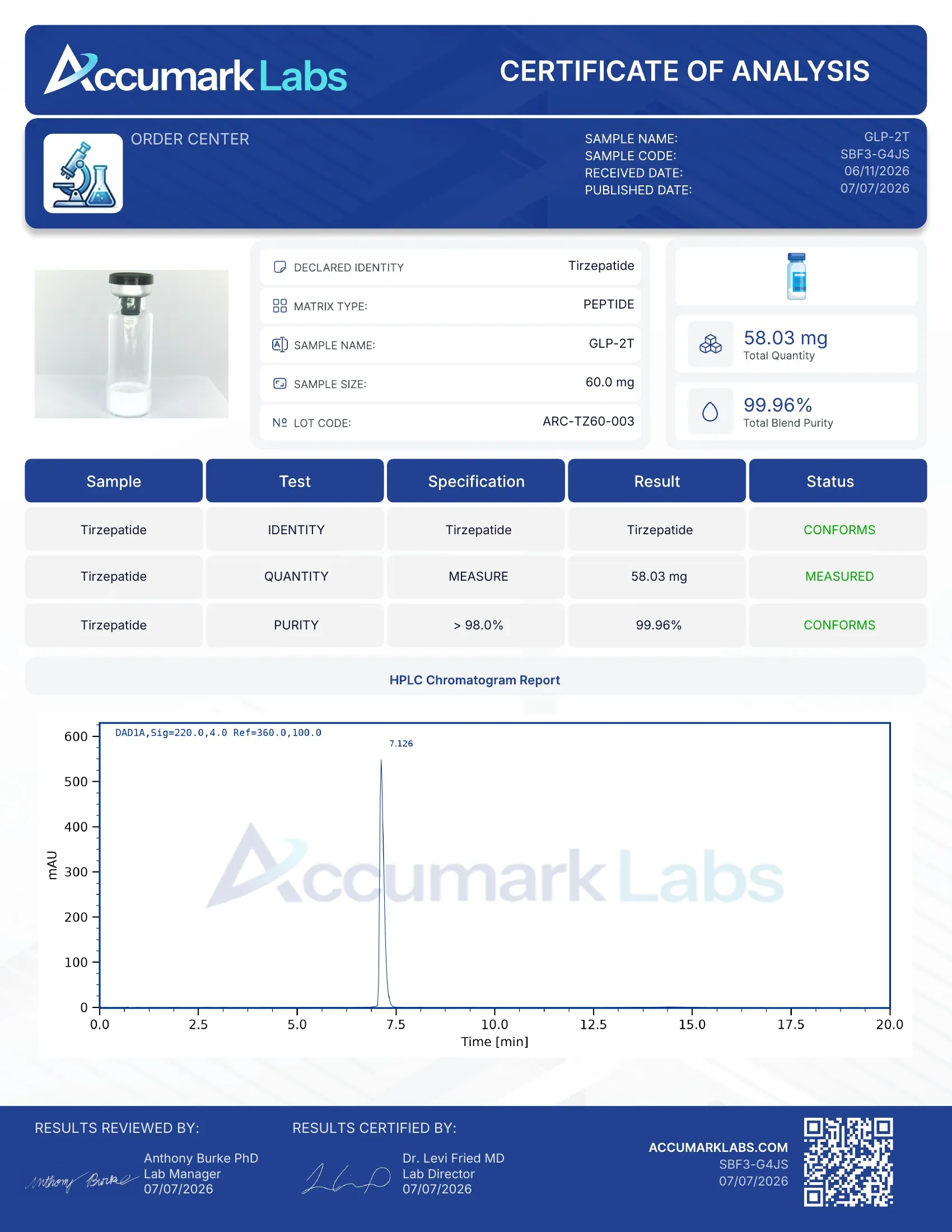
GLP-2 TRZ is provided as a lyophilized peptide vial with a supplied material quantity of 60mg. This single-unit presentation is intended for laboratory, analytical, and experimental applications where a clearly identified component and defined quantity are required. Classified within GLP peptides, this material supports disciplined study designs and controlled model development focused on peptide characterization and pathway analysis.
Within laboratory research contexts, GLP-2 TRZ can be applied to receptor-signaling investigations, pathway profiling, method development, and quantitative or qualitative analyses in experimental models. The lyophilized format facilitates precise material accounting and alignment with standard handling practices for solid-state research compounds. Researchers can incorporate this material into workflows that prioritize traceable quantities and consistent component identification for repeatable, well-documented studies.
- Active component: GLP-2 TRZ
- Component quantity: 60mg
- Format: lyophilized peptide vial
- Units per package: 1 vial
- Total material quantity: 60mg
- Most orders ship within 24 hours and arrive within 3 to 5 days of leaving our warehouse.
- Shipping is free on orders of $99+ (except Hawaii and Alaska).
- All orders ship in discreet packaging via USPS Ground Advantage mail.
Delivery restrictions vary by state.

This Product Contains

Research Applications
Our catalog supports controlled laboratory research across areas such as:
- Cellular Signaling — receptor activity, signaling pathways, and molecular interactions
- Metabolic Research — metabolic regulation and incretin receptor-signaling models
- Neurobiology — cognitive, behavioral, and stress-response pathways
- Immunology — immune signaling and host-response models
- Tissue Biology — extracellular-matrix signaling, cellular migration, and tissue remodeling research
- Mitochondrial Biology — cellular energy systems and aging-related pathways
- Endocrine Research — neuroendocrine and reproductive-axis signaling
- Pigment Biology — melanogenesis and related cellular pathways
Research relevance varies by compound and study design. Review the product information and batch-specific documentation before use. All products are intended strictly for laboratory research and are not for human or animal use, therapeutic use, or clinical application.
Research Materials Backed by Clear Documentation
- 99%+ Analytical Purity Where Confirmed by the Applicable Batch COA.
- Third-Party Testing Performed by an ISO/IEC 17025-Accredited Laboratory, Where Applicable.
- Batch-Specific Certificates of Analysis Available for Applicable Research Materials.
- Ships from the U.S.
Orders are dispatched from our U.S. fulfillment center, typically within 1–2 business days. - Clear Product Specifications
Strength, format, quantity, and available batch documentation are presented for review. - Research-First Standards
Our catalog and documentation are built for laboratory research—not consumer, wellness, or therapeutic use.
Storage & Handling
- Product-Specific Storage
This product is supplied as a freeze-dried material. Keep the original container sealed and follow the storage condition shown on the product label or available documentation.
Follow the format-specific instruction shown above. Product-specific label or documentation requirements take priority over the general handling guidance below. - Keep the Original Container Sealed
Until the material is needed for laboratory work, keep it in its original sealed container. Protect it from moisture, unnecessary light exposure, and avoidable temperature fluctuations. - Inspect the Package on Receipt
Check the container, seal, and packaging for visible damage, condensation, or signs of a temperature excursion. Record any issue before placing the material into laboratory storage. - Document Laboratory Handling
Record the material name, batch information, receipt date, storage location, and relevant handling conditions according to your laboratory’s procedures. - After Opening or Preparation
Once the original sealed state changes, follow the product documentation and your laboratory’s validated protocol. Clearly label any prepared material with the preparation date, composition, and applicable storage condition. - Avoid Unnecessary Temperature Cycling
Minimize repeated warming and cooling. Avoid repeated freeze-thaw cycles when frozen storage is required by the applicable protocol. - Use Material-Specific Conditions
Storage requirements can differ between lyophilized, liquid, and prepared materials. Do not apply one temperature, solvent, or stability period to every product.
Reliable U.S. Order Fulfillment
- Order Processing
In-stock orders are generally processed within 1–2 business days, Monday through Friday. Orders are not processed or shipped on weekends. - Standard Delivery
Domestic delivery typically takes 3–5 business days, depending on the destination and carrier. - Shipment Tracking
Tracking information is provided after the order ships so delivery progress can be monitored. - Careful, Discreet Packaging
Each order is packed with care to help protect the contents and maintain privacy during transit. - Nationwide U.S. Shipping
Orders can be shipped within the United States where permitted by applicable federal and state law. - Possible Delays
Carrier conditions, weather, holidays, backorders, and periods of high order volume may affect processing or delivery times.
Why Researchers Choose Primavora
Not all peptide vendors hold themselves to the same verification standards.
| VERIFICATION STANDARD | Primavora | GENERIC VENDORS |
|---|---|---|
| Purity Standard | Batch-Specific Analytical Purity — See Applicable COA | Often Not Disclosed |
| Third-Party Testing | Independent Laboratory | Testing Source Often Unclear |
| COA Published | Batch-Specific COA Available | Inconsistent Availability |
| Batch Traceability | Product, Strength & Lot Matched | Batch Match Often Unclear |
| U.S. Fulfillment | Ships Domestically | Often Ships From Overseas |
| Research Use Standard | Clearly Defined | Standards May Vary |
Frequently Asked Questions
Find answers to common questions about this product, its research context, Certificates of Analysis (COAs), ordering, and laboratory use.
GLP-2 TRZ appears to be a supplier-specific name for a GLP-2-oriented research compound or analog. Because the 'TRZ' suffix is not a universal scientific naming standard, the exact structure should be confirmed from the product specification or COA. It is therefore best understood as a GLP-2-pathway laboratory compound.
GLP-2-related compounds are usually studied for intestinal growth, mucosal integrity, nutrient-absorption physiology, and incretin-related signaling pathways. Research material of this type is intended for laboratory investigation of incretin-related signaling pathways, peptide characterization, batch identity, and analytical purity; the exact behavior of this material depends on the specific analog supplied.
GLP peptides — glucagon-like peptides — are a family of peptides derived from the post-translational processing of the proglucagon precursor. The main members are GLP-1 and GLP-2, both of which are produced primarily by intestinal L-cells. GLP-1 is studied in the context of insulin secretion, glucose metabolism, and incretin and metabolic receptor signaling, while GLP-2 is investigated for its role in intestinal epithelial biology.
A number of synthetic analogs and research compounds exist in this category, including semaglutide-class and tirzepatide-class sequences, as well as dual- and triple-agonist research peptides. All GLP peptide products from Prima Vora are lyophilized research materials intended solely for in vitro laboratory investigation.
Native GLP-1 has a very short half-life in plasma — on the order of a few minutes — because it is rapidly degraded by the enzyme dipeptidyl peptidase-4 (DPP-4). GLP analogs are engineered peptides that modify the native sequence or attach additional groups such as fatty acid chains, in order to resist DPP-4 degradation, extend half-life, and optimize receptor binding.
This extended stability is what makes GLP analogs useful in research as practical tools for studying the GLP-1 and related receptor systems in controlled experiments. The analogs differ from native GLP hormones primarily in their pharmacokinetic profile and, in some cases, their receptor selectivity across the GLP-1, GIP, and glucagon receptor families.
GLP-1 and GLP-2 are both produced from the proglucagon precursor. GLP-1 is studied in connection with the GLP-1 receptor, insulin secretion, and incretin and metabolic receptor signaling, while GLP-2 is studied primarily in connection with the GLP-2 receptor and intestinal epithelial biology. The two peptides share a common precursor but have different receptor targets and research focuses.
GLP-3 is not a classical endogenous peptide in the same way as GLP-1 and GLP-2. The term is sometimes used as a research label for engineered or triple-agonist peptides that combine activity at GLP-1, GIP, and glucagon receptors in a single molecule. In this sense, GLP-3 in research usually refers to a designed multi-target compound rather than a naturally occurring hormone.